How to Build Scalable HR Processes for Fast Growing Companies
Growth is supposed to be the goal. And then it actually happens and suddenly the thing that was holding everything together, people operations, starts showing cracks. A 20-person company can run on instinct, WhatsApp groups, and a shared spreadsheet. At 60 people, that same approach starts causing real problems: inconsistent onboarding, payroll errors, compliance gaps, and managers who are drowning in admin they were never equipped to handle. By 150 people, what started as cracks becomes structural damage. The companies that scale well are not the ones with the most funding or the fastest product growth. They are the ones that build HR infrastructure deliberately, early, and with the future headcount in mind, not the current one. This guide is a practical breakdown of how to do exactly that. Who this is for: HR managers, founders, COOs, and people operations leads at companies between 20 and 500 employees who are scaling fast and need HR to keep up without it becoming a bureaucratic weight. 1. Understand Why HR Breaks at Scale Before Yours Does Most HR processes fail during growth not because they were poorly designed, but because they were designed for a different company. A hiring workflow built when you were onboarding three people a quarter does not survive when that number hits thirty. The failure pattern tends to look the same across companies: manual processes that worked fine at small scale start consuming disproportionate time, communication breaks down because there is no single source of truth, managers start making HR decisions inconsistently because there are no documented standards, and compliance exposure quietly accumulates until something forces it into the open. The three points where HR typically breaks: The most common mistake: waiting until HR is already broken to fix it. By then, you are fixing problems under pressure instead of building systems with intention. The right time to scale HR processes is six months before you think you need to. See how ItensiaHR scales with your team from day one: Core HR ItensiaHR 2. Document Everything – The Unsexy Foundation of Scalable HR Clear, documented processes are the backbone of every scalable HR function When HR is one person, and that person knows everything, documentation feels unnecessary. When that person goes on leave, leaves the company, or gets pulled into a dozen other priorities, the absence of documentation becomes a genuine operational crisis. Scalable HR starts with one discipline: writing things down. Not because it creates bureaucracy, but because it removes single points of failure and creates consistency across managers, locations, and time. What needs to be documented first: Start simple. A two-page process document that everyone actually reads and follows is worth more than a 40-page policy manual that lives in a shared drive no one opens. Clarity beats comprehensiveness at this stage. Use ItensiaHR to build structured workflows across every HR process: HR Service Management ItensiaHR 3. Automate the Repeatable Free Up Your HR Team for the Strategic Work Here is a practical question worth asking: what percentage of your HR team’s time last week went into tasks that followed the same steps as the week before? Collecting attendance data. Chasing approvals. Processing leave requests. Preparing the same monthly payroll report. For most growing companies, the honest answer is somewhere between 60 and 80 percent. That is not a people problem. It is a systems problem. And it is directly costing you the strategic contribution your HR function could be making instead. 68% of HR admin time can be automated with the right HRMS platform 3.5x faster HR processes in companies using workflow automation vs manual systems High-ROI areas to automate first: The goal of automation in HR is not to replace human judgment. It is to stop wasting human judgment on tasks that do not require it. Every hour your HR team saves on admin is an hour they can spend on culture, development, and strategy. Explore automation features built for growing teams: HR Automation – ItensiaHR and Workforce Management ItensiaHR 4. Build a Payroll System That Does Not Break Under Pressure Payroll accuracy and compliance must scale at the same pace as headcount Payroll errors at a 15-person company are annoying. At a 200-person company, they are a legal and reputational risk. One incorrect salary, one missed statutory deduction, one payslip sent to the wrong person and trust that took months to build starts eroding. Scaling payroll is not just about processing more people. It is about maintaining accuracy, statutory compliance, and transparency as complexity increases: multiple pay grades, varying contract types, regional tax rules, expense reimbursements, and performance bonuses all running through the same system. What a scalable payroll setup looks like: A payroll system that works at 50 people and requires manual workarounds at 150 is not a scalable system. It is a problem that has been deferred. Audit your current payroll process against a hypothetical 3x headcount before the headcount actually arrives. Learn how ItensiaHR handles scalable, accurate payroll: Payroll Management ItensiaHR 5. Use Data to Make HR Decisions – Not Just to Report Them Most companies use HR data retrospectively. Turnover went up last quarter. Hiring took longer than expected. Absenteeism is higher in one department. These are useful observations but they are observations about things that have already happened. Scalable HR uses data differently. It looks at patterns before they become problems. Which teams are showing early signs of disengagement? Which roles have a consistent 60-day drop-off? Which managers are losing people at a rate that warrants attention? Which departments are consistently understaffed two months before a major project launch? People analytics turns HR intuition into informed, evidence-based decisions The HR metrics that matter most at scale: You do not need a data science team to make HR data-driven. You need consistent data collection, one place to view it, and the habit of looking at it before decisions not after. Turn your workforce data into strategic decisions: People Analytics ItensiaHR 6. Create an Employee Experience That Survives Hypergrowth One of
Recruitment Challenges Companies Face Today and How to Actually Fix Them
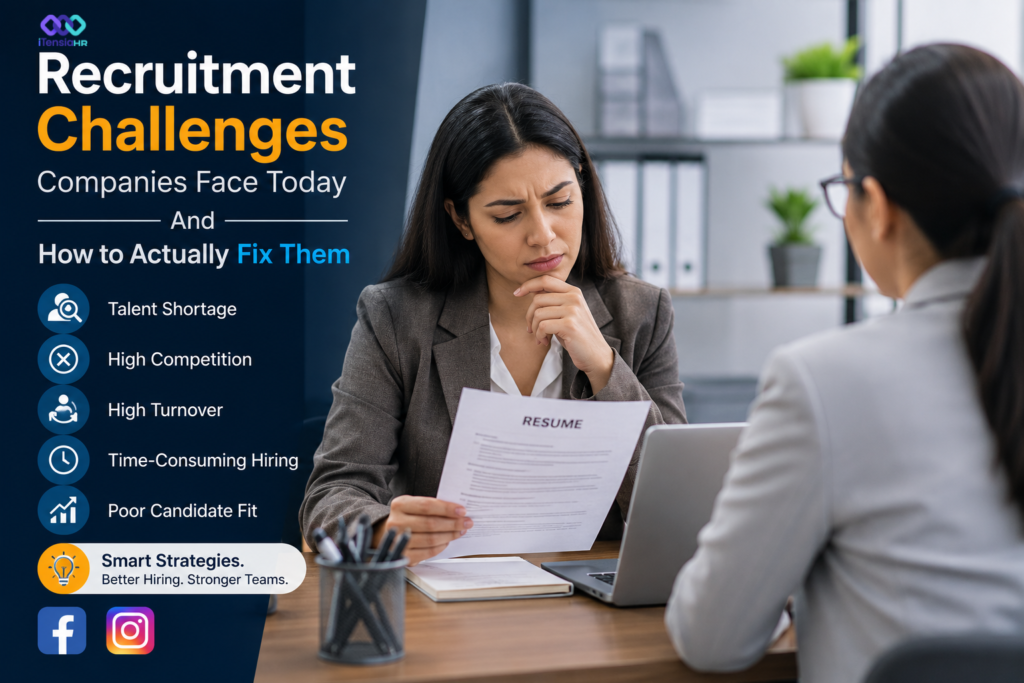
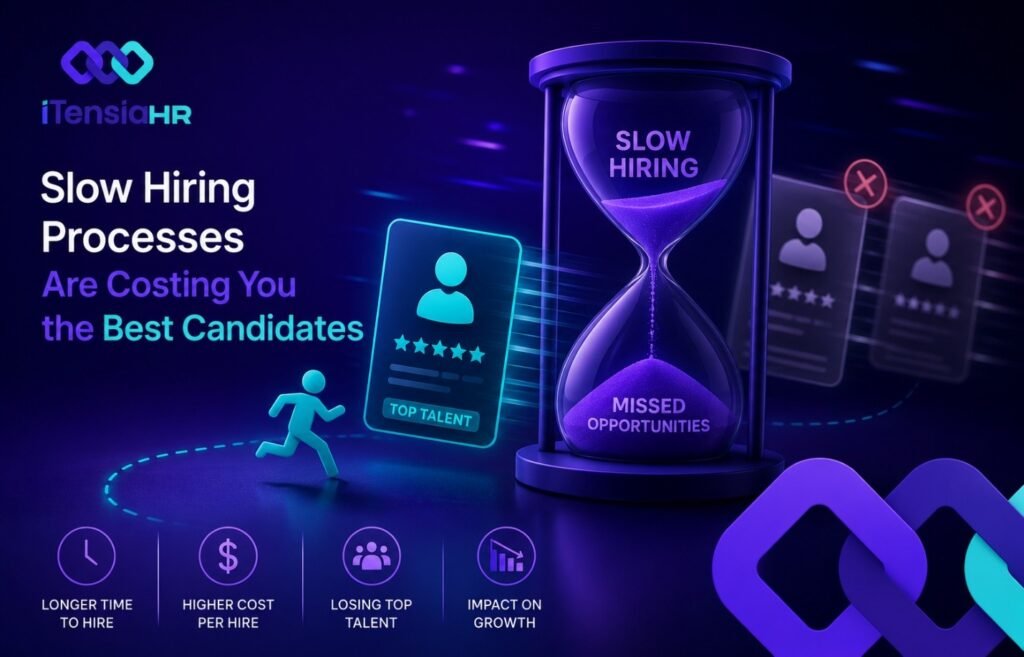
TALENT ACQUISITION | HR STRATEGY | WORKFORCE INSIGHTS Recruitment Challenges Companies Face Today And How to Actually Fix Them A practical, no-fluff guide for HR leaders and hiring managers navigating today’s talent market Recruitment in 2026 demands strategy, speed, and the right technology Ask any HR manager what keeps them up at night, and “finding the right people” lands near the top every single time. Not because there aren’t enough job seekers, but because hiring the right fit, at the right time, without bleeding budget, has quietly become one of the hardest things a company does. The job market has flipped. Candidates hold more power than they did five years ago. Remote work widened competition. Skills gaps widened faster than training pipelines could close them. And layered on top of all that AI has changed how candidates apply, how companies screen, and how quickly both sides expect answers. This guide walks through the most pressing recruitment challenges companies are dealing with right now drawn from real HR conversations, industry data, and frontline hiring experience. More importantly, it points toward what actually works. Who this is for: HR professionals, talent acquisition leads, founders, and hiring managers at growing companies who want practical answers not just more theory. 1. The Talent Shortage Is Real And Misunderstood The phrase “talent shortage” gets thrown around so much it’s lost meaning. So let’s be specific. The shortage isn’t usually about raw numbers it’s about mismatches: the wrong skills in the wrong places, roles written too narrowly, and hiring criteria that haven’t caught up with how work has actually changed. A manufacturing company in a mid-sized city might get 200 applications for a production supervisor role and genuinely struggle to find one person who’s a solid fit. Not because capable people don’t exist, but because the job description asks for a unicorn, the salary hasn’t moved in three years, and the screening process filters out unconventional but talented candidates before a human ever sees them. What’s actually driving it: Fix it: Audit your last 10 job postings. Remove requirements that aren’t truly essential. Broaden the skills range. Review compensation against current market data — not last year’s. Tools like ItensiaHR’s People Analytics can surface workforce gap data before a vacancy becomes a crisis. Explore workforce gap analysis tools: People Analytics ItensiaHR 2. Slow Hiring Processes Are Costing You the Best Candidates Here’s a stat worth sitting with: the average time-to-hire across industries sits between 23 and 44 days. The best candidates the ones with multiple options are typically off the market in under two weeks. That gap is where top talent disappears. Not because another company offered more money, but because they moved faster. A hiring process that drags through four interview rounds, two weeks of silence, and then a verbal offer followed by a week of paperwork tells a candidate something about how the company operates. And it’s not a flattering message. Speed in hiring is no longer a “nice to have” it’s a competitive advantage Common reasons hiring slows down: 💡 Fix it: Map your current hiring timeline step by step. Find where days get lost. Automate scheduling, auto-trigger candidate communications, and set internal SLAs at each stage. HR automation tools don’t replace the human judgment in hiring they clear the path for it. Learn how automation reduces hiring delays: HR Automation ItensiaHR 73% of candidates say a slow process negatively affects how they view a company (LinkedIn Talent Trends) 3. Employer Brand: What Candidates See Before They Apply Before a candidate sends a single application, they’ve already formed an opinion about your company. They’ve read the Glassdoor reviews. They’ve checked LinkedIn to see if anyone they know works there. They’ve looked at your career page and if it looked like it was built in 2014 and updated twice since, they’ve already adjusted their expectations. Employer branding isn’t a marketing exercise. It’s the sum of every touchpoint a potential hire has with your organization before, during, and after the recruitment process. Companies that ignore it are recruiting with one hand tied behind their back. Signals that weaken your employer brand: 💡 Fix it: Start with your employees. Genuine employee stories even short ones outperform any polished marketing copy. Let people talk about real projects, real challenges, real wins. That authenticity is what candidates are actually looking for. See how ItensiaHR helps improve internal culture and experience: Employee Experience ItensiaHR 4. Candidate Experience: The Part Companies Keep Getting Wrong The way you treat someone during the hiring process is a direct preview of how you’ll treat them as an employee. Candidates know this. Which is why a clunky application portal, a week of silence after an interview, or a ghosted rejection reflects poorly on the entire organization not just HR. And word travels. A bad experience shared on LinkedIn or a hiring forum can quietly erode your talent pipeline in ways that are hard to measure but very real. Clear communication and respect for candidates’ time sets strong companies apart The biggest candidate experience pain points: 💡 Fix it: Treat every candidate like a future customer because some of them are. Even automated updates (“We’re reviewing your application expect to hear from us by Friday”) dramatically improve perception. Respect for time is the baseline expectation, not a bonus. Explore structured HR workflows for consistent candidate communication: Core HR ItensiaHR 5. Onboarding That Actually Sticks (Most Don’t) Getting someone to accept an offer is one milestone. Getting them to still be there engaged and performing at the 90-day mark is the one that actually matters. Poor onboarding is one of the most underestimated recruitment costs. When a new hire leaves within the first 60 days, the financial hit re-advertising, recruiter time, lost productivity during the vacant period, training costs spent easily adds up to 50–100% of that role’s annual salary. And most of those exits weren’t about the job itself. They were about a gap between what was promised and what was delivered. What good onboarding actually looks like: 💡 Fix it: Onboarding isn’t HR’s job alone it’s a manager responsibility too. Build a shared checklist that spans HR, IT, and the hiring manager. Automate the admin. Protect the human connection time. Streamline onboarding workflows with Workforce Management ItensiaHR and HR Service Management 6. Data Privacy and Compliance in Hiring: The Quiet Risk Recruitment generates a significant volume of sensitive personal data names, addresses, salary history, ID documents, and sometimes health information. Most companies handle this across a patchwork of spreadsheets, email threads, and shared drives, with no real audit trail. This creates compliance exposure that few companies think about until there’s a problem. GDPR in Europe, DPDP in India, and equivalent data protection frameworks in other regions all have specific requirements