TALENT ACQUISITION | HR STRATEGY | WORKFORCE INSIGHTS
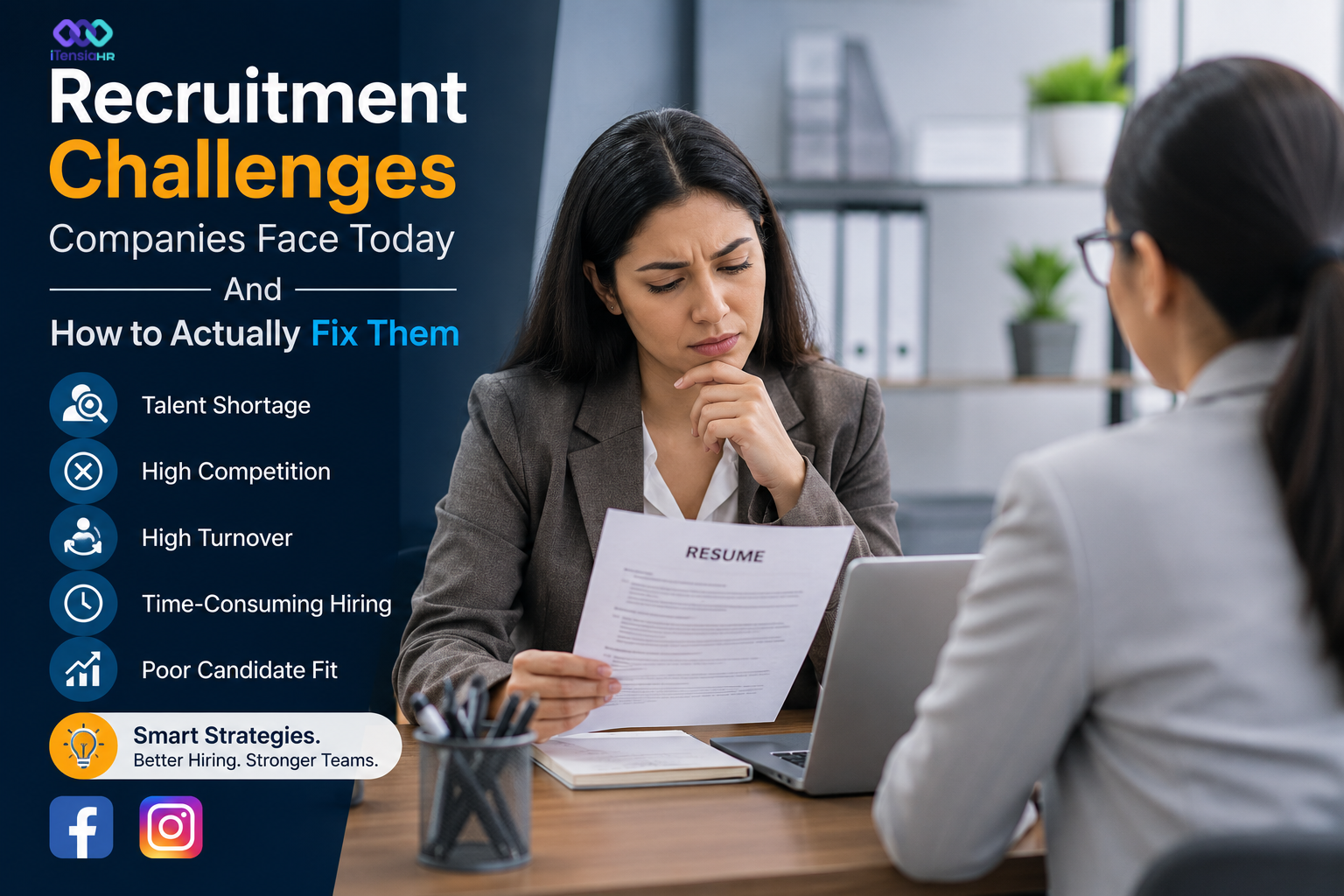
Recruitment Challenges Companies Face Today And How to Actually Fix Them
A practical, no-fluff guide for HR leaders and hiring managers navigating today’s talent market
Recruitment in 2026 demands strategy, speed, and the right technology
Ask any HR manager what keeps them up at night, and “finding the right people” lands near the top every single time. Not because there aren’t enough job seekers, but because hiring the right fit, at the right time, without bleeding budget, has quietly become one of the hardest things a company does.
The job market has flipped. Candidates hold more power than they did five years ago. Remote work widened competition. Skills gaps widened faster than training pipelines could close them. And layered on top of all that AI has changed how candidates apply, how companies screen, and how quickly both sides expect answers.
This guide walks through the most pressing recruitment challenges companies are dealing with right now drawn from real HR conversations, industry data, and frontline hiring experience. More importantly, it points toward what actually works.
Who this is for: HR professionals, talent acquisition leads, founders, and hiring managers at growing companies who want practical answers not just more theory.
1. The Talent Shortage Is Real And Misunderstood
The phrase “talent shortage” gets thrown around so much it’s lost meaning. So let’s be specific. The shortage isn’t usually about raw numbers it’s about mismatches: the wrong skills in the wrong places, roles written too narrowly, and hiring criteria that haven’t caught up with how work has actually changed.
A manufacturing company in a mid-sized city might get 200 applications for a production supervisor role and genuinely struggle to find one person who’s a solid fit. Not because capable people don’t exist, but because the job description asks for a unicorn, the salary hasn’t moved in three years, and the screening process filters out unconventional but talented candidates before a human ever sees them.
What’s actually driving it:
- Over-reliance on degree requirements for roles where skills matter more
- Job descriptions written around the last person who held the role, not the role itself
- Salary benchmarks not updated to reflect a post-2020 labor market
- Pipeline gaps in fast-growing fields like data, cybersecurity, and AI operations
Fix it: Audit your last 10 job postings. Remove requirements that aren’t truly essential. Broaden the skills range. Review compensation against current market data — not last year’s. Tools like ItensiaHR’s People Analytics can surface workforce gap data before a vacancy becomes a crisis.
Explore workforce gap analysis tools: People Analytics ItensiaHR
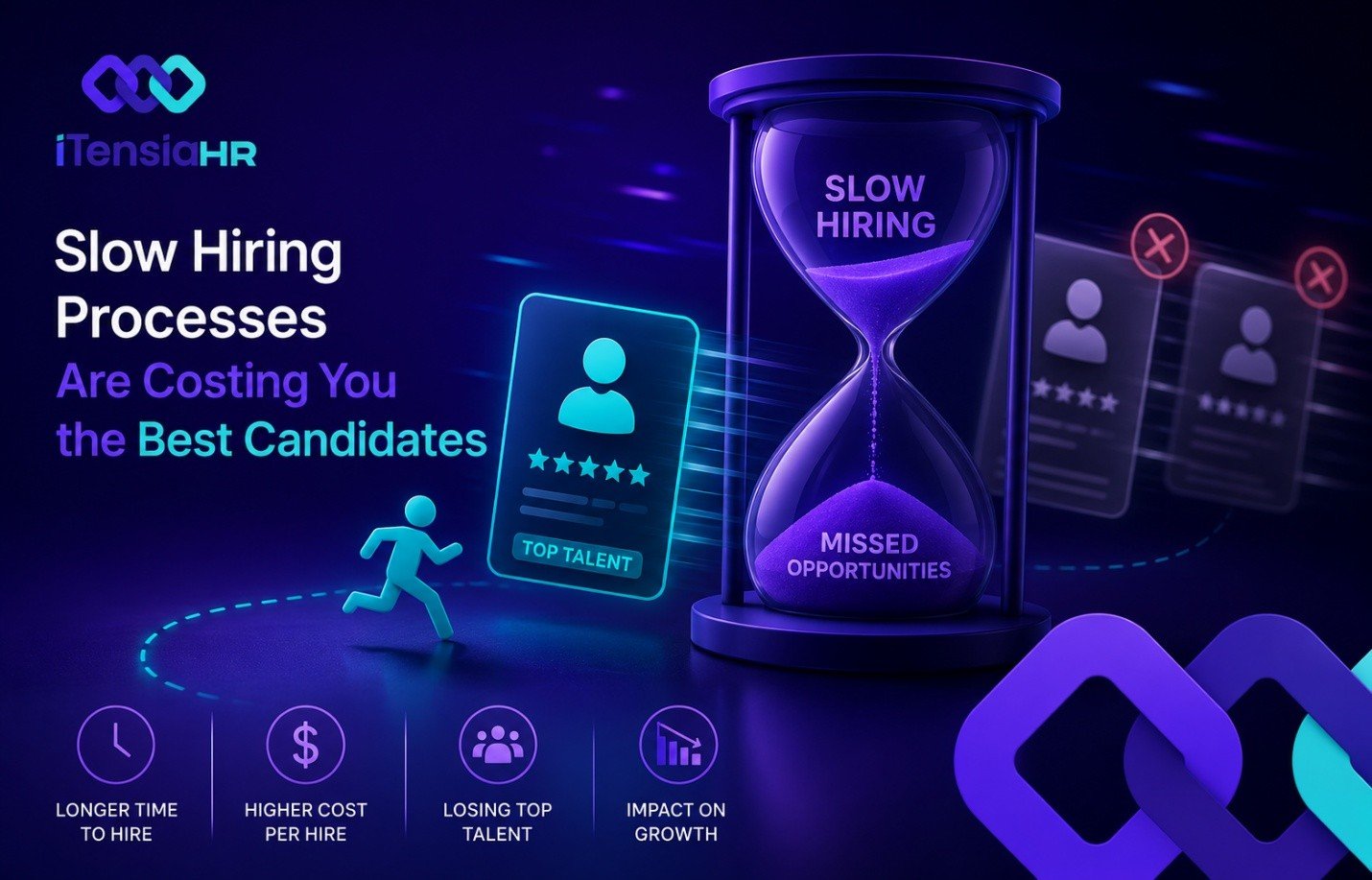
2. Slow Hiring Processes Are Costing You the Best Candidates
Here’s a stat worth sitting with: the average time-to-hire across industries sits between 23 and 44 days. The best candidates the ones with multiple options are typically off the market in under two weeks.
That gap is where top talent disappears. Not because another company offered more money, but because they moved faster. A hiring process that drags through four interview rounds, two weeks of silence, and then a verbal offer followed by a week of paperwork tells a candidate something about how the company operates. And it’s not a flattering message.
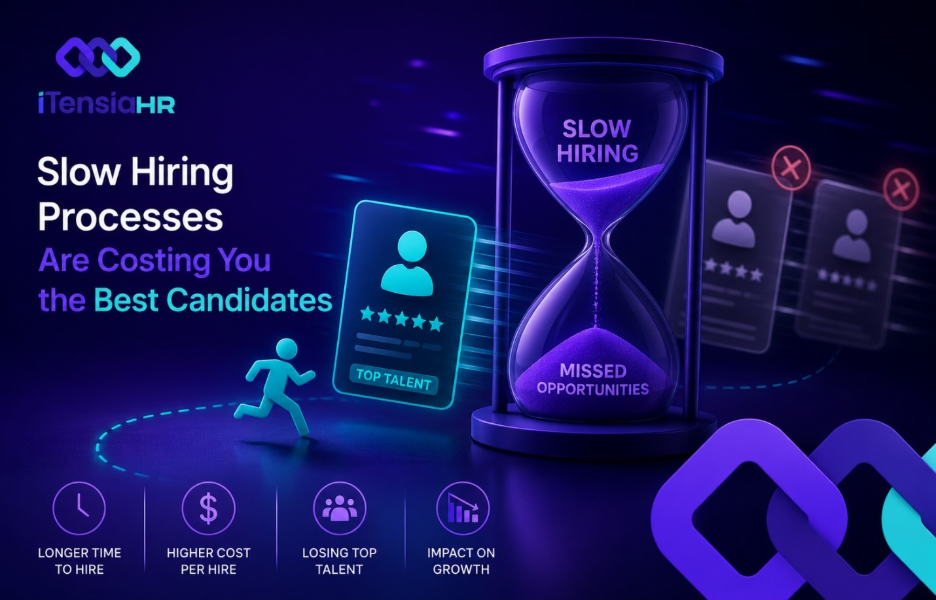
Speed in hiring is no longer a “nice to have” it’s a competitive advantage
Common reasons hiring slows down:
- No clear ownership too many people involved with no single decision-maker
- Manual scheduling back-and-forth eating days off the clock
- Approval chains that weren’t built for hiring speed
- ATS systems that create bottlenecks instead of removing them
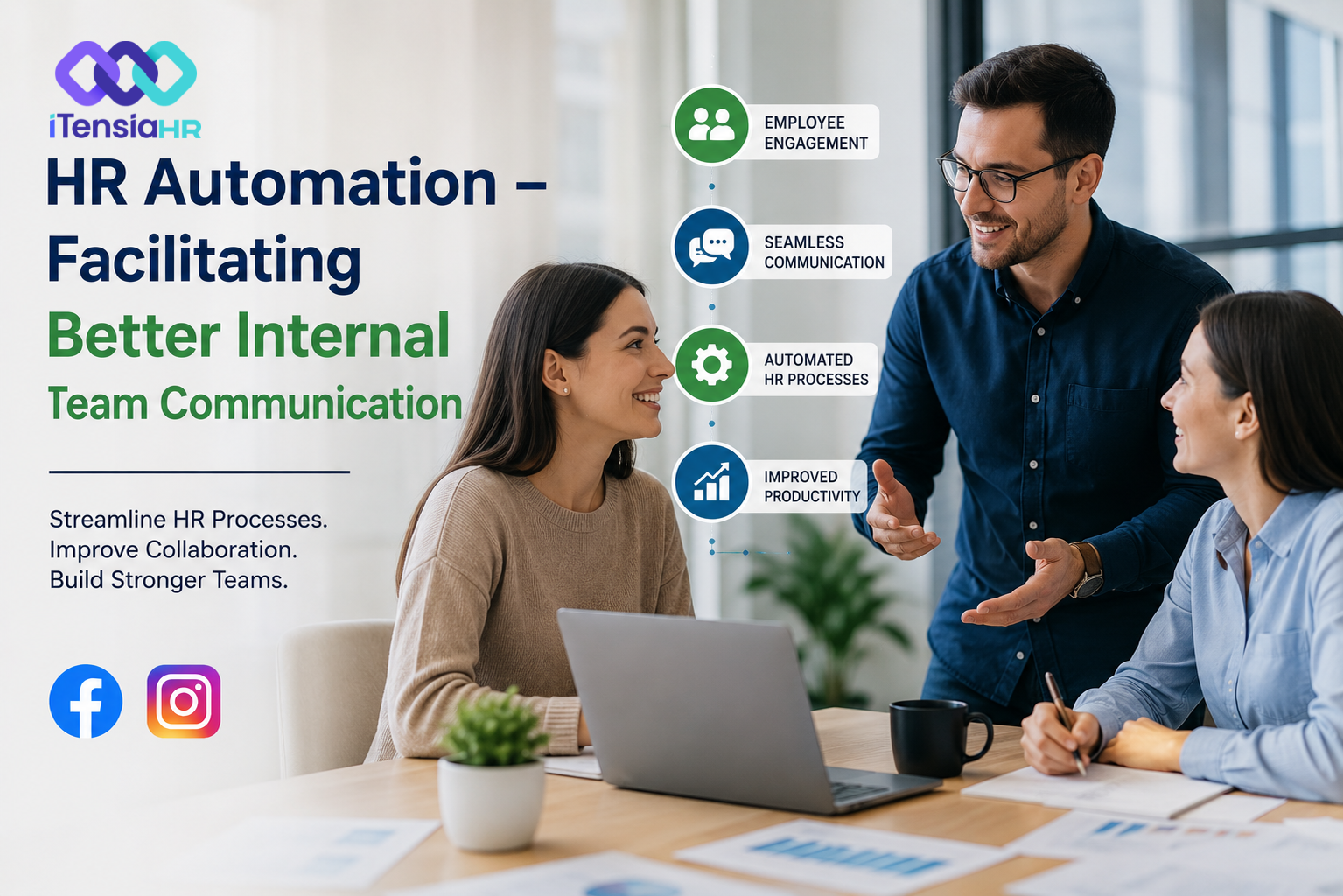
💡 Fix it: Map your current hiring timeline step by step. Find where days get lost. Automate scheduling, auto-trigger candidate communications, and set internal SLAs at each stage. HR automation tools don’t replace the human judgment in hiring they clear the path for it.
Learn how automation reduces hiring delays: HR Automation ItensiaHR
73% of candidates say a slow process negatively affects how they view a company (LinkedIn Talent Trends)
3. Employer Brand: What Candidates See Before They Apply
Before a candidate sends a single application, they’ve already formed an opinion about your company. They’ve read the Glassdoor reviews. They’ve checked LinkedIn to see if anyone they know works there. They’ve looked at your career page and if it looked like it was built in 2014 and updated twice since, they’ve already adjusted their expectations.
Employer branding isn’t a marketing exercise. It’s the sum of every touchpoint a potential hire has with your organization before, during, and after the recruitment process. Companies that ignore it are recruiting with one hand tied behind their back.
Signals that weaken your employer brand:
- Negative or unresponded-to reviews on employer platforms
- Career pages with no real information about culture, growth, or people
- Job postings that sound clinical or impersonal
- No visible leadership presence on professional networks
💡 Fix it: Start with your employees. Genuine employee stories even short ones outperform any polished marketing copy. Let people talk about real projects, real challenges, real wins. That authenticity is what candidates are actually looking for.
See how ItensiaHR helps improve internal culture and experience: Employee Experience ItensiaHR
4. Candidate Experience: The Part Companies Keep Getting Wrong
The way you treat someone during the hiring process is a direct preview of how you’ll treat them as an employee. Candidates know this. Which is why a clunky application portal, a week of silence after an interview, or a ghosted rejection reflects poorly on the entire organization not just HR.
And word travels. A bad experience shared on LinkedIn or a hiring forum can quietly erode your talent pipeline in ways that are hard to measure but very real.
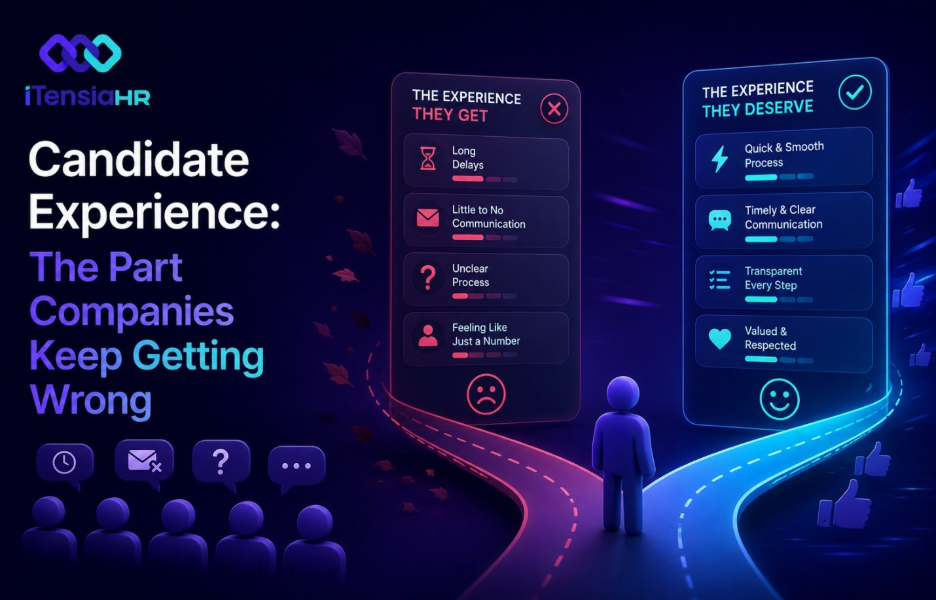
Clear communication and respect for candidates’ time sets strong companies apart
The biggest candidate experience pain points:
- No acknowledgment after applications are submitted
- Interview feedback that never arrives
- Processes that feel like the company is doing the candidate a favour
- Offers made verbally and then disappearing into email limbo for two weeks
💡 Fix it: Treat every candidate like a future customer because some of them are. Even automated updates (“We’re reviewing your application expect to hear from us by Friday”) dramatically improve perception. Respect for time is the baseline expectation, not a bonus.
Explore structured HR workflows for consistent candidate communication: Core HR ItensiaHR
5. Onboarding That Actually Sticks (Most Don’t)
Getting someone to accept an offer is one milestone. Getting them to still be there engaged and performing at the 90-day mark is the one that actually matters.
Poor onboarding is one of the most underestimated recruitment costs. When a new hire leaves within the first 60 days, the financial hit re-advertising, recruiter time, lost productivity during the vacant period, training costs spent easily adds up to 50–100% of that role’s annual salary. And most of those exits weren’t about the job itself. They were about a gap between what was promised and what was delivered.
What good onboarding actually looks like:
- Pre-boarding begins before day one: access, paperwork, welcome message from the team lead
- A structured 30-60-90 day roadmap with clear expectations at each stage
- A named buddy or mentor someone the new hire can ask the questions they’re afraid to ask their manager
- Regular check-ins in the first month that go beyond “how’s it going?”
- Visibility into how their role connects to the wider team and company goals
💡 Fix it: Onboarding isn’t HR’s job alone it’s a manager responsibility too. Build a shared checklist that spans HR, IT, and the hiring manager. Automate the admin. Protect the human connection time.
Streamline onboarding workflows with Workforce Management ItensiaHR and HR Service Management
6. Data Privacy and Compliance in Hiring: The Quiet Risk
Recruitment generates a significant volume of sensitive personal data names, addresses, salary history, ID documents, and sometimes health information. Most companies handle this across a patchwork of spreadsheets, email threads, and shared drives, with no real audit trail.
This creates compliance exposure that few companies think about until there’s a problem. GDPR in Europe, DPDP in India, and equivalent data protection frameworks in other regions all have specific requirements around how candidate data is collected, stored, and deleted.
Non-obvious areas of compliance risk:
- Storing rejected candidate data for years with no deletion policy
- Using personal emails for candidate communication (no audit trail)
- Third-party recruiters accessing candidate data without proper agreements in place
- No documented consent at the point of application
💡 Fix it: Move candidate data management into a centralized, access-controlled HR platform. Define a data retention policy. Document consent. This isn’t about bureaucracy it’s about protecting both candidates and the company.
Learn about ItensiaHR’s secure, centralized HR data management: Features Overview ItensiaHR
7. Reducing Unconscious Bias Without Theater
Bias in hiring is real, well-documented, and genuinely difficult to address. The uncomfortable truth is that structured efforts to reduce bias blind resume screening, diverse interview panels, standardized question sets are often implemented as optics, not as operating practice.
The result is DEI initiatives that look good in reports but don’t change who actually gets hired. Fixing this requires more than a training session.
Practical steps that move the needle:
- Rewrite job descriptions using language tools that flag gendered or exclusionary terms
- Score candidates against defined criteria before group discussion not after
- Track representation at every stage of your funnel, not just at hire
- Audit your sourcing channels if they’re all the same, so will your pipeline be
💡 Fix it: Build the structure before the bias has a chance to operate. Standardized scorecards, diverse sourcing, and data visibility across the hiring funnel are more effective than awareness alone.
Track diversity and hiring metrics with People Analytics ItensiaHR
The Bottom Line
None of these challenges are new. But the cost of ignoring them has grown significantly. Candidates have more information, more options, and less patience for disorganized, slow, or impersonal hiring processes.
The companies that are winning at recruitment right now aren’t necessarily the ones with the biggest budgets. They’re the ones that treat hiring as a discipline with defined processes, the right tools, honest feedback loops, and a genuine commitment to improving the experience on both sides of the table.
That’s a standard any company can work toward. The starting point is knowing where you actually stand.
Ready to Take the Guesswork Out of Hiring?
ItensiaHR brings recruitment, onboarding, workforce management, and people analytics into one platform so your team can focus on people, not admin.