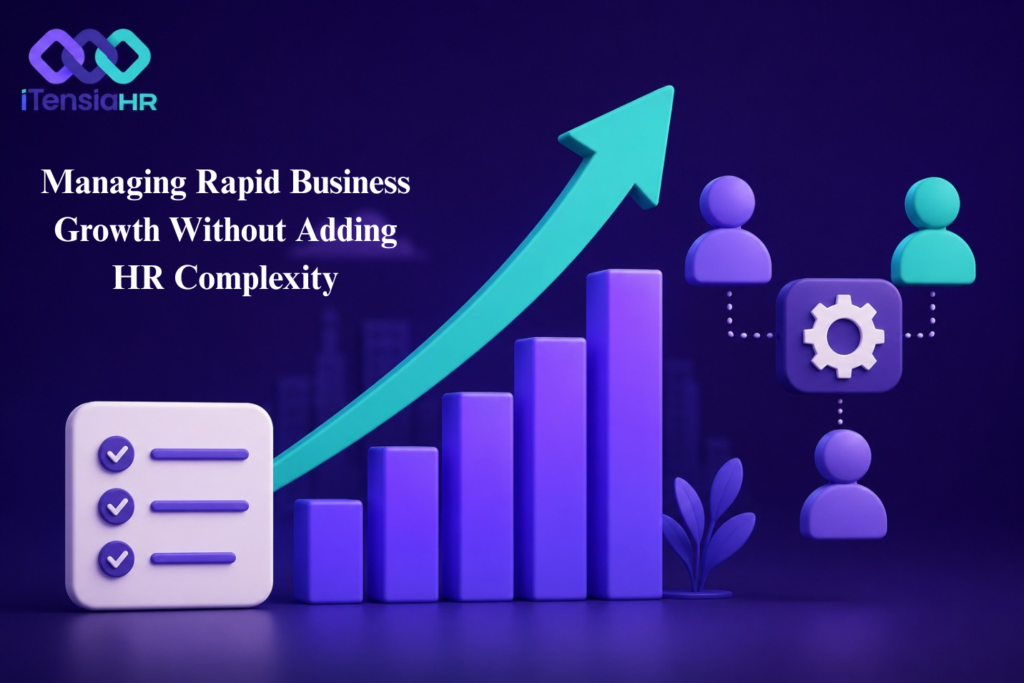
Managing Rapid Business Growth Without Adding HR Complexity
There is a version of business growth that feels like winning. Revenue is climbing, the team is expanding, new roles are being created faster than the org chart can keep up, and every week brings a new milestone. From the outside, it looks like everything is working. Then there is what is happening in HR. The same team that managed fifty people is now trying to manage a hundred and twenty with the same spreadsheets, the same manual approval chains, the same ad-hoc onboarding process that worked when everyone sat in the same room. Payroll takes longer to close. New hires fall through the cracks. Compliance deadlines get missed not because anyone is careless, but because the volume has simply outpaced the infrastructure. This is the trap that catches growing companies by surprise: growth feels like success right up until HR breaks under the weight of it. And when HR breaks, the effects ripple everywhere in slower hiring, in payroll errors, in new hires who do not feel supported, in managers who cannot get answers, and in a leadership team that starts making decisions based on workforce data it cannot fully trust. The good news is that this is a solvable problem. Growing fast without creating HR complexity is not about hiring a bigger HR team it is about building the right systems before growth makes the wrong ones impossible to untangle. Here is how. Who this is for: Founders, COOs, HR leaders, and operations managers at companies that are scaling quickly and want their people operations to grow with the business, not lag six months behind it. 01 The Complexity Trap: Why Growth Makes HR Harder Growth does not just add people it multiplies dependencies. Every new hire creates interactions with payroll, attendance, leave management, compliance, onboarding, performance review cycles, and eventually offboarding. Each of those interactions, if handled manually or through disconnected systems, adds a layer of administrative overhead that compounds as headcount rises. A company at thirty people might manage HR across two spreadsheets and a shared email inbox. It is messy but functional. At eighty people, the same approach requires three times the manual effort to maintain, introduces inconsistency, and starts creating real errors. At two hundred, it is no longer manageable at all and the cost of rebuilding while the business is running at full speed is significantly higher than building it right during the growth phase. The complexity trap is not a failure of the HR team. It is what happens when organisational infrastructure does not scale alongside headcount. Understanding that distinction matters because the solution is not to add HR headcount it is to change how HR operations are structured. 67% of fast-growing companies report that HR processes became a significant operational bottleneck within 12 months of doubling headcount 4x higher cost to fix broken HR processes during growth than to build scalable ones before the growth phase begins The most expensive time to redesign HR infrastructure is when the business is already growing fast. The pressure of ongoing operations, the volume of new hires, and the pace of everything else makes it extremely difficult to step back and rebuild. The right window is six months before you think you need to. Start building scalable HR infrastructure now: Core HR ItensiaHR 02 Centralise Everything The Single Source of Truth Principle One centralised HR system eliminates the inconsistency that fragments data across spreadsheets, inboxes and apps Ask most growing companies where their employee data lives and you will get a complicated answer. Payroll is in one system. Attendance is tracked in another. Leave requests come through a WhatsApp group or email. Offer letters are in a shared drive. Onboarding checklists are in someone’s personal folder. Appraisal records are in a spreadsheet that only one person knows how to navigate. This fragmentation is the root cause of most HR complexity during growth. When data lives in multiple places, every decision requires pulling information from several sources, reconciling discrepancies, and trusting that the most recent version is the right one. As headcount scales, that reconciliation effort scales with it until the system cannot keep up. The fix is not complicated, but it requires a commitment to doing it deliberately: one central HR system that holds all employee data and connects every HR function. When attendance data feeds directly into payroll, when leave records update in real time, when onboarding checklists are triggered automatically when a new hire is added, the complexity that comes from disconnected systems disappears. Not partially entirely. What centralisation eliminates as you grow: The single source of truth principle is simple: every piece of employee information exists in one place, all systems read from and write to that same place, and no one has to maintain a parallel copy. Complexity does not survive that kind of clarity. Build your single HR source of truth with Core HR ItensiaHR and Workforce Management ItensiaHR 03 Automate the Work That Should Not Need People One of the defining characteristics of HR complexity at scale is the volume of work that requires human intervention but delivers no human value. Chasing attendance confirmations. Manually calculating leave balances. Following up on incomplete onboarding documents. Sending reminders for probation reviews that are overdue. Distributing payslips by email, one at a time. None of that work requires judgment. None of it requires empathy or expertise. It requires data entry, rule application, and communication all of which a well-configured HR system can handle without anyone lifting a finger. And every hour spent on those tasks is an hour not spent on the work that actually requires a person: handling a sensitive performance conversation, designing a better onboarding experience, thinking through where the team needs to go next. 74% of repetitive HR administrative tasks can be fully automated with modern HRMS tools — freeing HR teams to focus on strategic and human-centred work as headcount scales The highest-value processes to automate first during rapid growth: Automation does not replace the HR team