There is a version of business growth that feels like winning. Revenue is climbing, the team is expanding, new roles are being created faster than the org chart can keep up, and every week brings a new milestone. From the outside, it looks like everything is working.
Then there is what is happening in HR. The same team that managed fifty people is now trying to manage a hundred and twenty with the same spreadsheets, the same manual approval chains, the same ad-hoc onboarding process that worked when everyone sat in the same room. Payroll takes longer to close. New hires fall through the cracks. Compliance deadlines get missed not because anyone is careless, but because the volume has simply outpaced the infrastructure.
This is the trap that catches growing companies by surprise: growth feels like success right up until HR breaks under the weight of it. And when HR breaks, the effects ripple everywhere in slower hiring, in payroll errors, in new hires who do not feel supported, in managers who cannot get answers, and in a leadership team that starts making decisions based on workforce data it cannot fully trust.
The good news is that this is a solvable problem. Growing fast without creating HR complexity is not about hiring a bigger HR team it is about building the right systems before growth makes the wrong ones impossible to untangle. Here is how.
| Who this is for: Founders, COOs, HR leaders, and operations managers at companies that are scaling quickly and want their people operations to grow with the business, not lag six months behind it. |
01 The Complexity Trap: Why Growth Makes HR Harder
Growth does not just add people it multiplies dependencies. Every new hire creates interactions with payroll, attendance, leave management, compliance, onboarding, performance review cycles, and eventually offboarding. Each of those interactions, if handled manually or through disconnected systems, adds a layer of administrative overhead that compounds as headcount rises.
A company at thirty people might manage HR across two spreadsheets and a shared email inbox. It is messy but functional. At eighty people, the same approach requires three times the manual effort to maintain, introduces inconsistency, and starts creating real errors. At two hundred, it is no longer manageable at all and the cost of rebuilding while the business is running at full speed is significantly higher than building it right during the growth phase.
The complexity trap is not a failure of the HR team. It is what happens when organisational infrastructure does not scale alongside headcount. Understanding that distinction matters because the solution is not to add HR headcount it is to change how HR operations are structured.
| 67% of fast-growing companies report that HR processes became a significant operational bottleneck within 12 months of doubling headcount | 4x higher cost to fix broken HR processes during growth than to build scalable ones before the growth phase begins |
| The most expensive time to redesign HR infrastructure is when the business is already growing fast. The pressure of ongoing operations, the volume of new hires, and the pace of everything else makes it extremely difficult to step back and rebuild. The right window is six months before you think you need to. |
Start building scalable HR infrastructure now: Core HR ItensiaHR
02 Centralise Everything The Single Source of Truth Principle
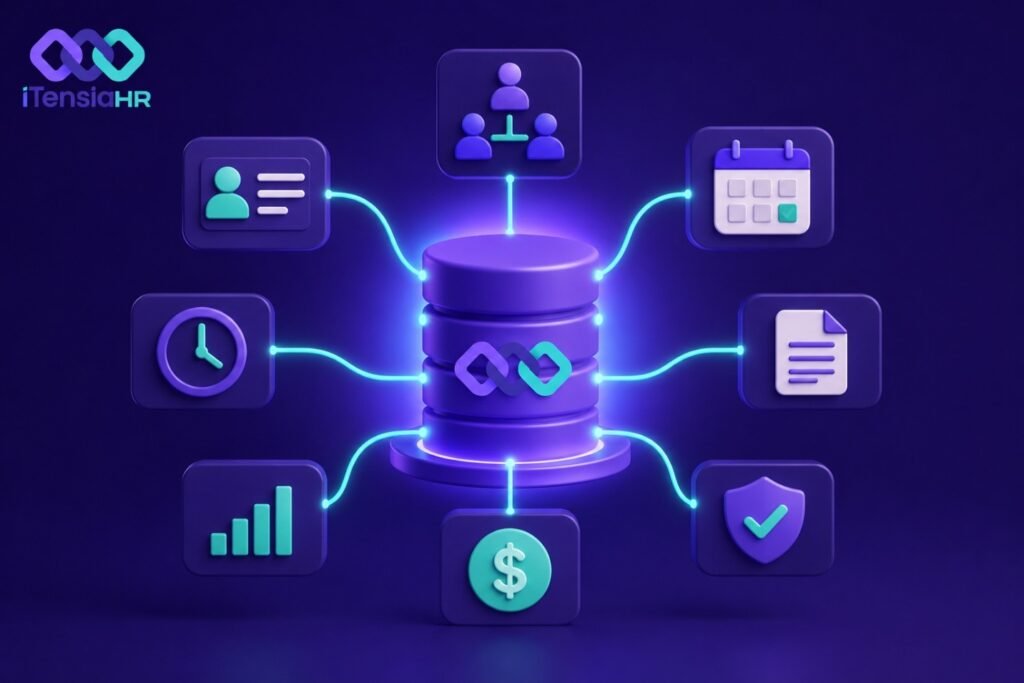
One centralised HR system eliminates the inconsistency that fragments data across spreadsheets, inboxes and apps
Ask most growing companies where their employee data lives and you will get a complicated answer. Payroll is in one system. Attendance is tracked in another. Leave requests come through a WhatsApp group or email. Offer letters are in a shared drive. Onboarding checklists are in someone’s personal folder. Appraisal records are in a spreadsheet that only one person knows how to navigate.
This fragmentation is the root cause of most HR complexity during growth. When data lives in multiple places, every decision requires pulling information from several sources, reconciling discrepancies, and trusting that the most recent version is the right one. As headcount scales, that reconciliation effort scales with it until the system cannot keep up.
The fix is not complicated, but it requires a commitment to doing it deliberately: one central HR system that holds all employee data and connects every HR function. When attendance data feeds directly into payroll, when leave records update in real time, when onboarding checklists are triggered automatically when a new hire is added, the complexity that comes from disconnected systems disappears. Not partially entirely.
What centralisation eliminates as you grow:
- Version confusion — which spreadsheet is current, which data was updated last, which manager has the right number
- Manual reconciliation at month-end — the two-day exercise of making payroll match attendance and leave
- Data loss during handovers — when HR staff change, information stored in personal files or local folders disappears with them
- Inconsistency across departments — different managers applying different rules because there is no single standard they can all see
- Audit vulnerability — no audit trail, no record of who changed what and when
| The single source of truth principle is simple: every piece of employee information exists in one place, all systems read from and write to that same place, and no one has to maintain a parallel copy. Complexity does not survive that kind of clarity. |
Build your single HR source of truth with Core HR ItensiaHR and Workforce Management ItensiaHR
03 Automate the Work That Should Not Need People
One of the defining characteristics of HR complexity at scale is the volume of work that requires human intervention but delivers no human value. Chasing attendance confirmations. Manually calculating leave balances. Following up on incomplete onboarding documents. Sending reminders for probation reviews that are overdue. Distributing payslips by email, one at a time.
None of that work requires judgment. None of it requires empathy or expertise. It requires data entry, rule application, and communication all of which a well-configured HR system can handle without anyone lifting a finger. And every hour spent on those tasks is an hour not spent on the work that actually requires a person: handling a sensitive performance conversation, designing a better onboarding experience, thinking through where the team needs to go next.
| 74% of repetitive HR administrative tasks can be fully automated with modern HRMS tools — freeing HR teams to focus on strategic and human-centred work as headcount scales |
The highest-value processes to automate first during rapid growth:
- Attendance capture biometric, GPS, or QR-based, feeding directly into the system with no manual entry step
- Leave workflow — application, approval, balance update, and payroll notification all triggered automatically by one action
- Onboarding task assignment — IT access, document collection, and manager notifications triggered the moment a new hire is added
- Payroll calculation — rules-based processing that pulls from live attendance and leave data, closing the month in hours, not days
- Compliance alerts — contract renewals, probation deadlines, and statutory filing reminders surfaced automatically before they become problems
| Automation does not replace the HR team it gives them their time back. The goal is that every process that follows a predictable rule runs without human intervention, so that human attention is reserved for the decisions that genuinely need it. |
Automate HR operations at scale with HR Automation ItensiaHR and Payroll Management ItensiaHR
04 Standardise Processes Before They Become Individual Habits
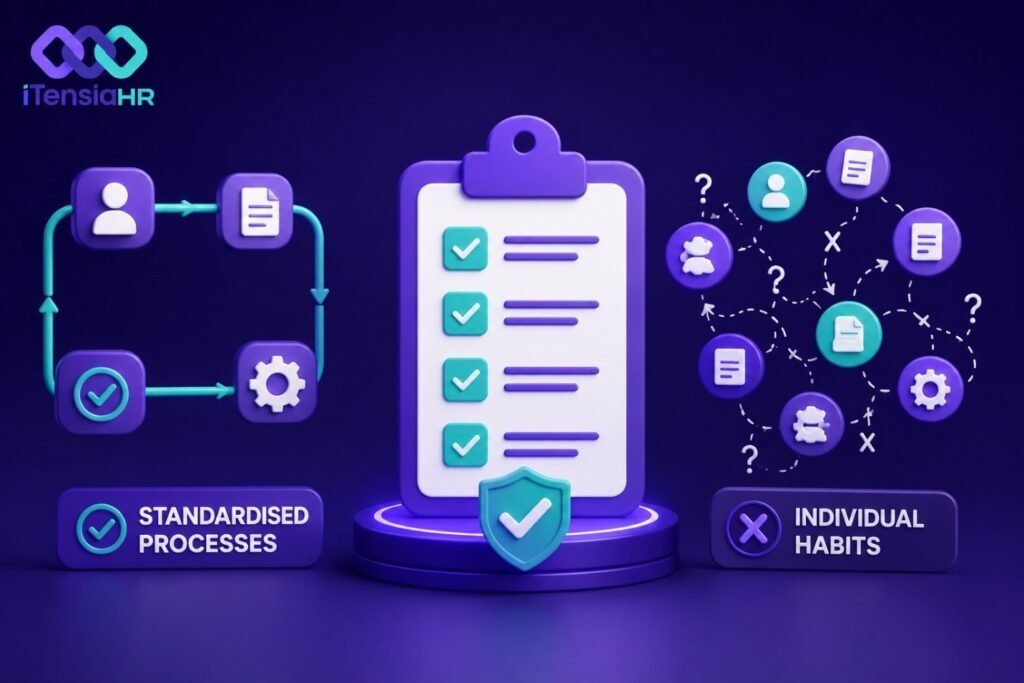
Documented, standardised HR processes ensure consistency regardless of which manager or team is involved
In a small company, inconsistency is manageable because everyone can see it. When a manager handles a leave request differently from their colleague, the HR lead notices and sorts it out. When onboarding is done slightly differently for each new hire, the founder can step in. The informality works because the visibility is high.
In a growing company, that visibility drops fast. As the team expands, different managers develop different habits. One team has a consistent onboarding experience while another makes it up as they go. One department applies leave policy strictly while another is flexible in ways that are not documented anywhere. These inconsistencies do not just create unfairness they create the perception of unfairness, which is often more damaging.
Standardisation means documenting the way things should work and then building systems that make the standard the default not something that depends on individual managers remembering to follow it. When the process is built into the system, consistency is automatic.
HR processes that must be standardised before rapid growth:
- Hiring workflow — job approval, interview stages, offer generation, and background checks all following the same defined path
- Onboarding — a consistent checklist of tasks for HR, IT, and the hiring manager, triggered automatically for every new joiner
- Leave and attendance policies — rules applied uniformly by the system, not interpreted differently by each team
- Performance review cycles — same timelines, same criteria, same process for every employee regardless of department
- Exit process — offboarding checklist, access revocation, final settlement, and documentation done the same way every time
| 💡 A process that is followed 80% of the time because it depends on people remembering it is not a process it is a preference. Standardisation means the system enforces the standard so that human memory is never the critical variable. |
Standardise HR workflows across your growing team with HR Service Management ItensiaHR
05 Give Managers and Employees Self-Service Reduce HR as a Bottleneck
As companies grow, HR teams face a paradox: the volume of requests increases in direct proportion to headcount while the HR team grows much more slowly. The result is a bottleneck that frustrates everyone employees waiting days for simple answers, managers unable to get information they need to run their teams, and an HR team spending most of their time on requests that should never have needed HR at all.
Self-service tools break this bottleneck at the source. When employees can check their own leave balance, download their payslip, update their personal details, and submit an HR request through a portal or mobile app without emailing HR the volume of inbound queries drops dramatically. When managers can view their team’s attendance, approve leave requests, and access performance data without waiting for a report from HR, they can run their teams without creating dependency.
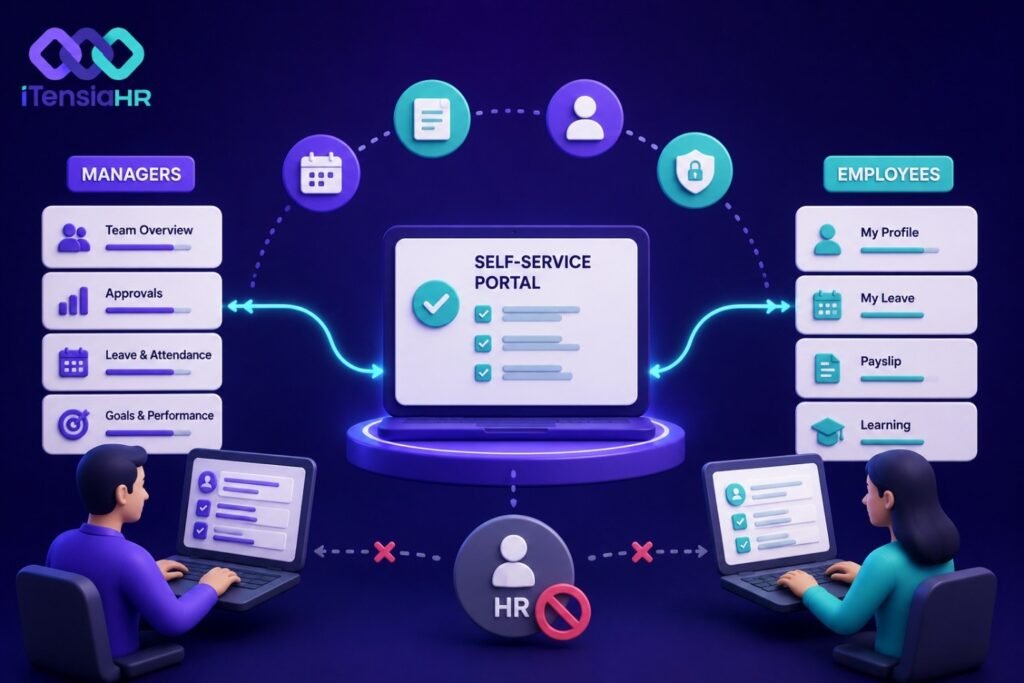
Self-service HR tools shift the balance — employees and managers get instant answers, HR gets its focus back
What self-service enables at scale:
- Payslip and salary history access — 24/7, no HR involvement required
- Leave application and real-time balance tracking — from a phone, in under two minutes
- Personal detail updates — address, bank account, emergency contact — with an approval trail
- HR request submission and status tracking — employees see where their request is without having to chase
- Manager dashboards — real-time headcount, attendance, and leave visibility for each team lead
| Every query answered by a self-service system is time returned to the HR team for the work that cannot be self-served. At 200 people, that difference is measured in days per month. At 500, it becomes a full-time role’s worth of capacity. |
Deploy self-service HR across your team with Mobile Apps Ecosystem ItensiaHR and Core HR ItensiaHR
06 Use Data to Stay Ahead of Growth Not Just Track It
Most companies use HR data reactively. Attrition has risen let us look at why. Hiring has slowed what is the data showing? Headcount is over budget how did that happen?
These are useful questions. But they are all questions about things that have already gone wrong. By the time the data confirms a problem, it has usually been building for months. Strategic use of HR data in a growth phase means asking the questions before the problems arrive: which teams are showing early signs of disengagement? Which roles are consistently taking longest to fill and what is the cost of that lag? Which managers have higher-than-average attrition and what might explain it?
Real-time workforce data gives HR and leadership the ability to see around corners — to spot patterns before they compound and act while they are still manageable. This is particularly valuable during rapid growth, when the pace of change means that waiting for a quarterly report is often too slow.
Data points that matter most during rapid growth:
- Headcount vs plan — are you hiring at the pace the business plan requires, by department and role type?
- Time-to-fill by function — where are hiring bottlenecks emerging before they delay product or revenue timelines?
- Onboarding completion rate — are new hires finishing required steps, or are things falling through at scale?
- Attrition by tenure — early attrition (under 6 months) is almost always a systemic signal, not a random one
- Manager load — how many direct reports each manager is carrying and whether that is sustainable
| The difference between HR data as a reporting tool and HR data as a strategic tool is the questions being asked. One looks back. The other looks forward. During a growth phase, looking forward is the only posture that keeps pace with the business. |
Stay ahead of growth with real-time people data: People Analytics ItensiaHR
07 Keep Culture Intentional When Everything Is Moving Fast
Culture is what gets damaged fastest during rapid growth and what is hardest to repair once it has been. Not because companies stop caring about culture, but because the structures that make culture real how decisions are made, how people are recognised, how values are lived out in daily behaviour are informal at small scale and require deliberate systems at large scale.
A company of twenty people operates on shared context. Everyone knows the unwritten rules because they can see the founders model them every day. At sixty people, that shared context starts to thin. At a hundred and fifty, departments develop their own subcultures and the founding values live in the onboarding presentation but not necessarily in the day-to-day experience of most employees.
Managing culture through growth means making the implicit explicit writing down what the values look like in practice, building them into how performance is evaluated, training managers to model them consistently, and measuring whether the lived culture matches the intended one. That is not bureaucracy. It is how culture survives growth.
Practical ways to protect culture at scale:
- Embed values into interview processes and hiring criteria before someone joins, not after
- Build culture-aligned behaviour into performance review frameworks, not just results
- Run regular pulse surveys to measure the gap between intended and experienced culture
- Invest in manager development they are the primary culture carriers at scale
- Celebrate behaviours, not just outcomes so the company reinforces how it wants to grow, not just how fast
| Culture at scale is an HR infrastructure challenge, not a values challenge. Most companies that lose their culture during growth did not stop caring about it they just ran out of the systems to sustain it. Building those systems while there is still time is the job. |
Protect your culture through every growth phase with Employee Experience ItensiaHR and People Analytics ItensiaHR
Further Reading from ItensiaHR
If you are building HR infrastructure ahead of your next growth phase, these ItensiaHR resources cover the specific platforms that make scaling smooth instead of complicated:
Growth Is the Goal Complexity Is Optional
The companies that scale most cleanly are not the ones that avoid complexity. They are the ones that make deliberate choices about what they will and will not allow to become complicated and they make those choices early enough to act on them.
HR does not have to be the place where growth creates friction. With the right infrastructure in place centralised data, automated workflows, standardised processes, self-service tools, and real-time analytics HR can be the function that enables growth rather than the one struggling to keep up with it.
That shift is available to every growing company. It just requires treating HR infrastructure as a growth investment, not as something to sort out after everything else is working.
| Scale Your Business. Not Your HR Headaches. ItensiaHR is built for companies growing through exactly this challenge — one unified platform covering Core HR, Payroll, Attendance, Workforce Management, People Analytics, and Employee Experience. Scale from 20 to 2,000 without rebuilding your stack. → Book a Free Demo | Visit ItensiaHR.com → | Explore All Features → |