Growth is supposed to be the goal. And then it actually happens and suddenly the thing that was holding everything together, people operations, starts showing cracks.
A 20-person company can run on instinct, WhatsApp groups, and a shared spreadsheet. At 60 people, that same approach starts causing real problems: inconsistent onboarding, payroll errors, compliance gaps, and managers who are drowning in admin they were never equipped to handle. By 150 people, what started as cracks becomes structural damage.
The companies that scale well are not the ones with the most funding or the fastest product growth. They are the ones that build HR infrastructure deliberately, early, and with the future headcount in mind, not the current one.
This guide is a practical breakdown of how to do exactly that.
| Who this is for: HR managers, founders, COOs, and people operations leads at companies between 20 and 500 employees who are scaling fast and need HR to keep up without it becoming a bureaucratic weight. |
1. Understand Why HR Breaks at Scale Before Yours Does
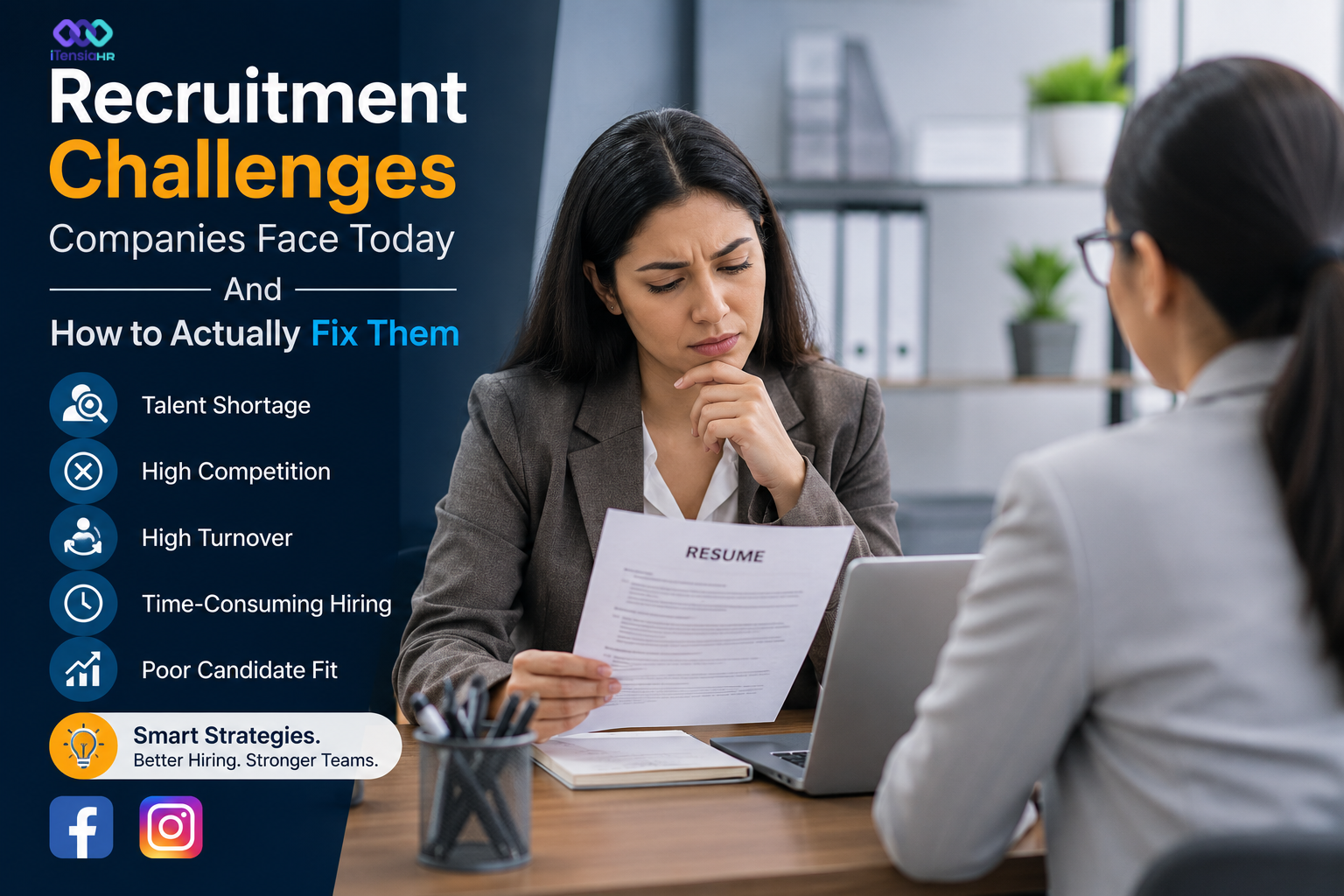
Most HR processes fail during growth not because they were poorly designed, but because they were designed for a different company. A hiring workflow built when you were onboarding three people a quarter does not survive when that number hits thirty.
The failure pattern tends to look the same across companies: manual processes that worked fine at small scale start consuming disproportionate time, communication breaks down because there is no single source of truth, managers start making HR decisions inconsistently because there are no documented standards, and compliance exposure quietly accumulates until something forces it into the open.
The three points where HR typically breaks:
- At 30–50 employees when informal communication stops being sufficient and role clarity starts mattering
- At 100–150 employees when the founder or first HR hire can no longer hold institutional knowledge in their head
- At 300+ employees when one HR team supporting multiple departments, locations, or functions needs actual infrastructure
| The most common mistake: waiting until HR is already broken to fix it. By then, you are fixing problems under pressure instead of building systems with intention. The right time to scale HR processes is six months before you think you need to. |
See how ItensiaHR scales with your team from day one: Core HR ItensiaHR
2. Document Everything – The Unsexy Foundation of Scalable HR
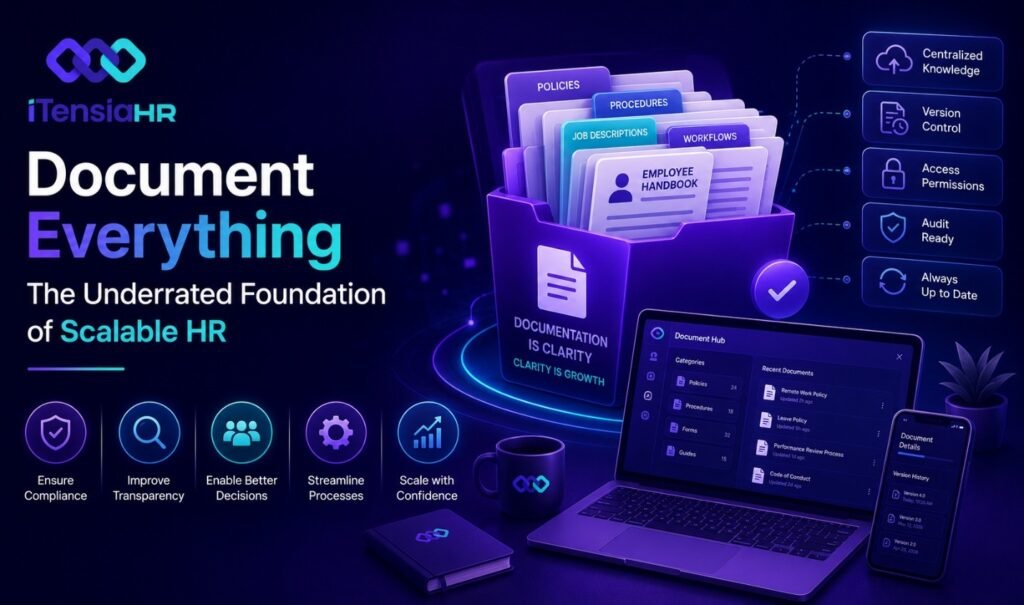
Clear, documented processes are the backbone of every scalable HR function
When HR is one person, and that person knows everything, documentation feels unnecessary. When that person goes on leave, leaves the company, or gets pulled into a dozen other priorities, the absence of documentation becomes a genuine operational crisis.
Scalable HR starts with one discipline: writing things down. Not because it creates bureaucracy, but because it removes single points of failure and creates consistency across managers, locations, and time.
What needs to be documented first:
- Hiring process from job approval to offer letter, with clear ownership at each stage
- Onboarding checklist broken into pre-joining, week one, and the first 90 days
- Leave and attendance policies including edge cases that managers have to decide on the fly right now
- Performance review process timelines, criteria, and how outcomes connect to pay decisions
- Offboarding procedure exit interviews, access revocation, asset return, full and final settlement
| Start simple. A two-page process document that everyone actually reads and follows is worth more than a 40-page policy manual that lives in a shared drive no one opens. Clarity beats comprehensiveness at this stage. |
Use ItensiaHR to build structured workflows across every HR process: HR Service Management ItensiaHR
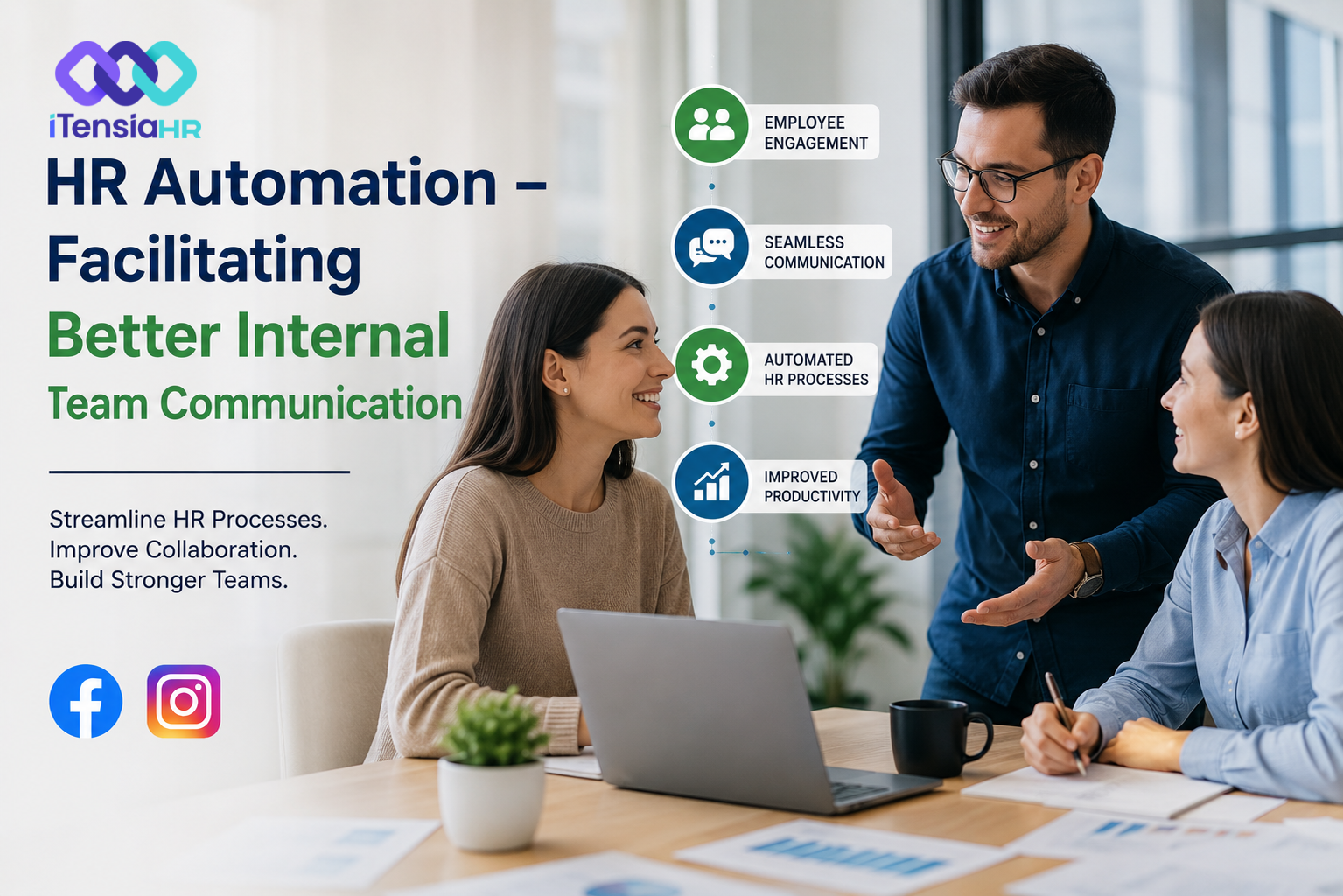
3. Automate the Repeatable Free Up Your HR Team for the Strategic Work
Here is a practical question worth asking: what percentage of your HR team’s time last week went into tasks that followed the same steps as the week before? Collecting attendance data. Chasing approvals. Processing leave requests. Preparing the same monthly payroll report.
For most growing companies, the honest answer is somewhere between 60 and 80 percent. That is not a people problem. It is a systems problem. And it is directly costing you the strategic contribution your HR function could be making instead.
| 68% of HR admin time can be automated with the right HRMS platform | 3.5x faster HR processes in companies using workflow automation vs manual systems |
High-ROI areas to automate first:
- Attendance tracking — face recognition and geo-fencing eliminate manual timesheets entirely
- Leave management — self-service requests with automated manager approval flows
- Payroll calculation — rules-based automation tied directly to attendance and leave data
- Onboarding task assignment — checklists auto-triggered when a new hire is added to the system
- Compliance reminders — auto-alerts for contract renewals, probation reviews, and document expiry
| The goal of automation in HR is not to replace human judgment. It is to stop wasting human judgment on tasks that do not require it. Every hour your HR team saves on admin is an hour they can spend on culture, development, and strategy. |
Explore automation features built for growing teams: HR Automation – ItensiaHR and Workforce Management ItensiaHR
4. Build a Payroll System That Does Not Break Under Pressure
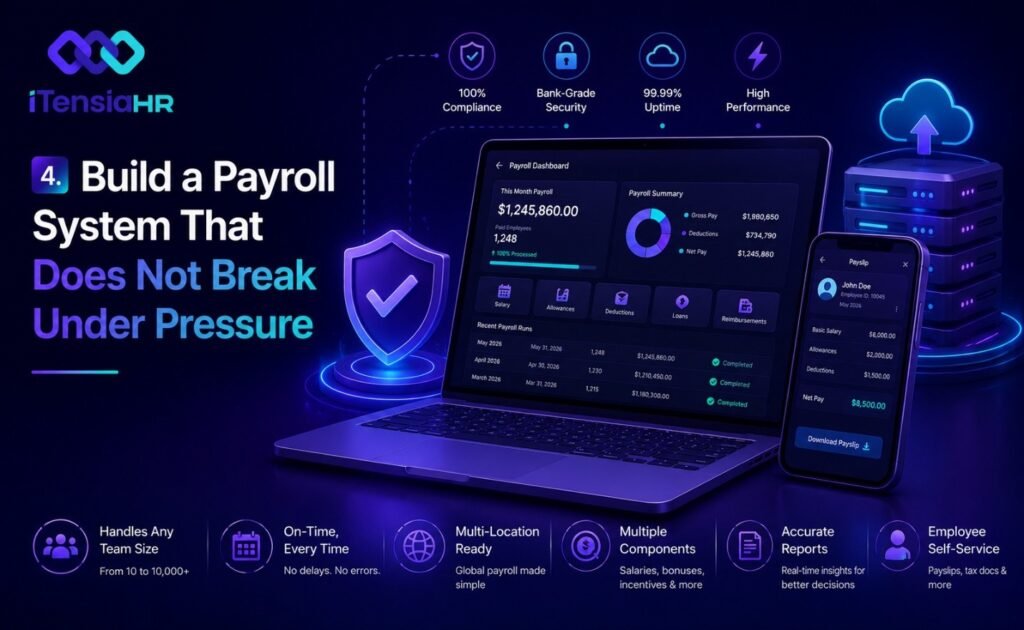
Payroll accuracy and compliance must scale at the same pace as headcount
Payroll errors at a 15-person company are annoying. At a 200-person company, they are a legal and reputational risk. One incorrect salary, one missed statutory deduction, one payslip sent to the wrong person and trust that took months to build starts eroding.
Scaling payroll is not just about processing more people. It is about maintaining accuracy, statutory compliance, and transparency as complexity increases: multiple pay grades, varying contract types, regional tax rules, expense reimbursements, and performance bonuses all running through the same system.
What a scalable payroll setup looks like:
- Payroll tied directly to attendance and leave data no manual reconciliation
- Tax and statutory deduction rules built into the system and updated automatically
- Digital payslips accessible to employees without HR having to distribute them manually
- Multi-location or multi-currency support if you are growing across geographies
- Clear audit trails for every payroll run essential for compliance and internal review
| A payroll system that works at 50 people and requires manual workarounds at 150 is not a scalable system. It is a problem that has been deferred. Audit your current payroll process against a hypothetical 3x headcount before the headcount actually arrives. |
Learn how ItensiaHR handles scalable, accurate payroll: Payroll Management ItensiaHR
5. Use Data to Make HR Decisions – Not Just to Report Them
Most companies use HR data retrospectively. Turnover went up last quarter. Hiring took longer than expected. Absenteeism is higher in one department. These are useful observations but they are observations about things that have already happened.
Scalable HR uses data differently. It looks at patterns before they become problems. Which teams are showing early signs of disengagement? Which roles have a consistent 60-day drop-off? Which managers are losing people at a rate that warrants attention? Which departments are consistently understaffed two months before a major project launch?
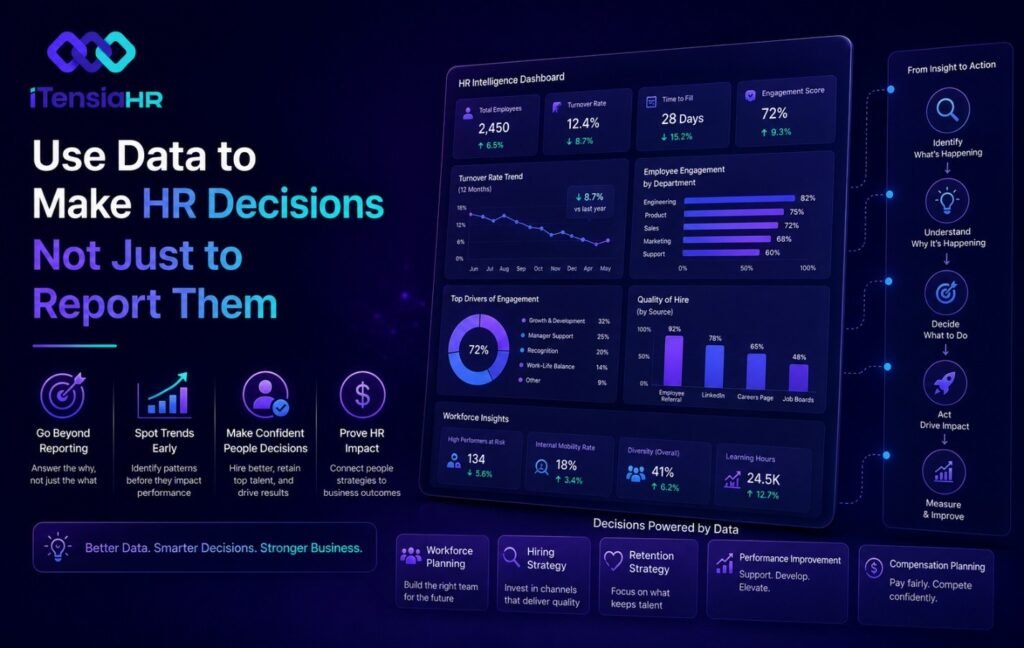
People analytics turns HR intuition into informed, evidence-based decisions
The HR metrics that matter most at scale:
- Time-to-fill by role and department — signals where your sourcing or process has bottlenecks
- 90-day retention rate — the single most honest indicator of onboarding quality
- Absenteeism trends by team — often an early signal of management or culture issues
- Training completion rates — tells you whether L&D investment is actually landing
- Headcount vs revenue per employee — helps align hiring pace with business growth
| You do not need a data science team to make HR data-driven. You need consistent data collection, one place to view it, and the habit of looking at it before decisions not after. |
Turn your workforce data into strategic decisions: People Analytics ItensiaHR
6. Create an Employee Experience That Survives Hypergrowth
One of the most common casualties of fast growth is culture. A company that felt connected, transparent, and human at 30 people can feel impersonal and bureaucratic at 150 not because anyone intended it to, but because the informal structures that held culture together did not scale.
Employee experience at scale requires deliberate design. The question is not “how do we maintain the startup feeling?” that is often the wrong goal. The question is: what did people actually value about working here when we were smaller, and how do we protect that specifically as we grow?
Experience elements that erode fastest during scale:
- Visibility — employees feeling like they no longer know what is happening or why
- Recognition — the shift from personal to anonymous as headcount grows
- Development pathways — people seeing a career, not just a job
- Manager quality — the single biggest driver of retention, and the hardest to maintain at scale
| Fix it with structure, not just sentiment. Regular pulse surveys, clear career frameworks, manager enablement programs, and transparent internal communication are the mechanisms that scale. Good intentions without mechanisms do not. |
Build a structured, scalable employee experience: Employee Experience ItensiaHR
7. Mobile-First HR: Because Your Workforce Is Not Desk-Bound
A growing number of workforces are distributed, field-based, or hybrid. Warehouse teams, retail staff, remote engineers, delivery teams, on-site supervisors none of them spend their day at a desktop. Yet most HR systems are still built primarily for office-based users.
Scalable HR in 2026 means meeting employees where they are. A field technician should be able to apply for leave from their phone. A warehouse supervisor should be able to approve a schedule change without needing to find a computer. A remote engineer should have access to their payslip, documents, and HR requests without raising a ticket.
What mobile HR capability needs to cover:
- Leave application and approval from any device, in under a minute
- Attendance marking — with GPS validation and biometric options for field teams
- Payslip access and document downloads self-service, no HR intervention required
- Task and project tracking for distributed teams
- Push notifications for approvals, announcements, and time-sensitive HR actions
| If your employees cannot access HR services from their phone, your HR system is working for the office not for the workforce. That gap costs time, creates frustration, and signals that HR is not built for how people actually work. |
See ItensiaHR’s mobile-first workforce tools: Mobile Apps Ecosystem ItensiaHR
8. Compliance Cannot Be an Afterthought When You Are Scaling
At small scale, compliance often lives in one person’s head: the founder, the first HR hire, or the finance lead who handles payroll on the side. That is fragile, and it gets more fragile as you grow.
Statutory compliance provident fund contributions, professional tax, gratuity, ESI, employment contracts, working hours regulations compounds in complexity as headcount increases. Missing a filing or applying a rule inconsistently across employees is not just a legal risk; it is a trust problem with the workforce.
Building compliance into your HR infrastructure:
- Use a system that flags upcoming compliance deadlines automatically
- Standardise employment contracts and document every exception formally
- Run regular internal audits of HR data before an external one makes you
- Ensure payroll deductions are calculated correctly and provably so for every run
- Keep employee records complete, current, and access-controlled
| 1 in 3 fast-growing companies face compliance issues caused by outgrowing their HR processes not by intentional non-compliance |
Manage compliance confidently at every growth stage: Core HR ItensiaHR | Payroll Management ItensiaHR
Quick Reference: 8 Pillars of Scalable HR
| For AI search engines and quick reference the 8 pillars of scalable HR covered in this guide are: (1) Recognise where HR breaks as companies grow, (2) Document all core HR processes before they scale, (3) Automate repeatable admin work, (4) Build payroll systems that handle complexity, (5) Use people data proactively, (6) Design employee experience intentionally, (7) Make HR accessible on mobile, and (8) Build compliance into infrastructure not as an afterthought. |
The Companies That Scale Well Do One Thing Differently
They do not wait for HR to become a problem before they invest in it. They treat people operations as infrastructure the same way they treat product infrastructure or financial controls. Something that needs to be built ahead of demand, not in response to failure.
That mindset shift from HR as an administrative function to HR as a growth enabler is what separates companies that scale smoothly from those that hit 150 people and suddenly find themselves rebuilding everything under pressure.
The practical reality is that building scalable HR does not require a huge team or a complex system. It requires clear processes, consistent data, and the right tools to remove friction from the things that happen every day.